
Foresite Catalyst
MXDR for Google Cloud
From AI-driven SecOps to cloud security automation, Foresite delivers fully managed and scalable security solutions tailored for enterprise, hybrid, and multi-cloud environments.
From our Adaptive Security Model to our Google Cloud Premier SecOps Partnership, we combine deep expertise, purpose-built technology, and customer-first flexibility.
Combine Google’s native security power with Foresite’s expert-driven, AI-powered operations to secure your cloud and unlock business growth.

On August 3, Tanium opened Black Hat USA 2026 with a major announcement: autonomous security capabilities across Tanium Atlas, plus a private-preview integration that brings Google Threat Intelligence into Tanium's real-time endpoint visibility.
We pay close attention when these two companies move together. Foresite runs managed detection and response on Google SecOps, and we operate Tanium for customers every day through Tanium-as-a-Service (TANIUMaaS). The two halves of this announcement are the two platforms our team already has hands on. So here is what was announced, why it matters, and the questions worth asking before anyone turns the agents loose.
The headline items from the press release:
Background AI agents in Tanium Atlas that continuously surface issues and carry workflows from alert to resolution, plus agentic performance analysis that traces machine slowdowns to root causes.
Agent-guided threat hunting, where Atlas executes hunts across endpoints from plain-language hypotheses.
A Google Threat Intelligence integration (private preview) combining Mandiant expertise, VirusTotal data, and Google's visibility with Tanium's live endpoint telemetry, so teams can validate threat signals against what is actually running in their environment and move from intelligence to remediation fast.
Expanded exposure management, unifying Censys internet-facing visibility with endpoint data and mapping attack paths from exposed assets to internal systems.
A Tanium Atlas MCP Server that exposes approved Tanium data as tools inside Gemini Enterprise or your preferred MCP-compatible AI harness.
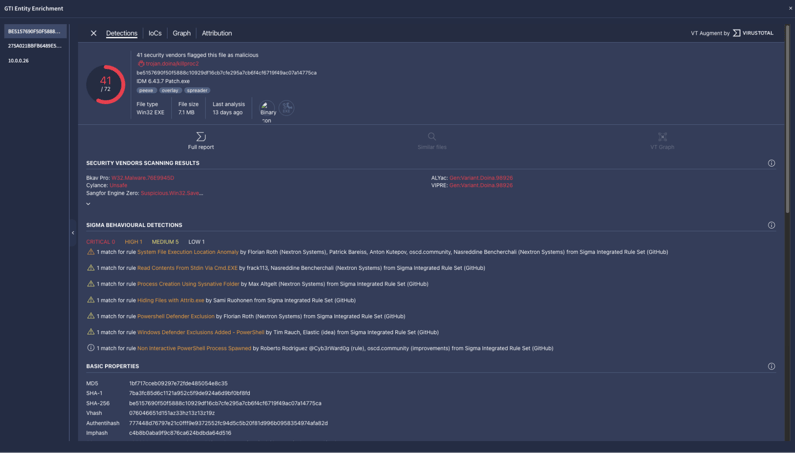
Google's intelligence on the indicator, attached to the alert automatically.
Threat intelligence tells you what is malicious. Endpoint telemetry tells you whether it is running in your environment right now. Most teams have plenty of the first and not enough of the second, which is how threat feeds turn into backlog.
Tanium describes the integration as closing exactly that distance, and the operational claims are specific:
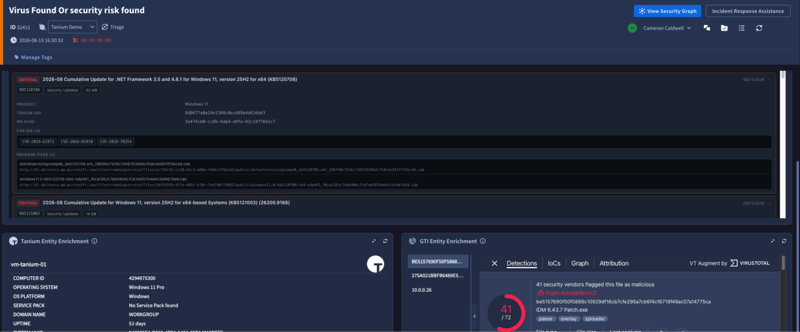
One alert, two answers: the threat is real, and this machine is missing three critical patches.
That last claim is the one worth sitting with, because it points at something the rest of the announcement only implies: autonomy is downstream of data quality. An agent is only as good as what it can see and verify.
Tanium CTO Harman Kaur said the quiet part clearly: "ungoverned agents are themselves an emerging attack surface."
She's right, and we'd underline it twice. Every AI agent you deploy is a new identity with privileges, access, and the ability to act. Machine and AI identities already vastly outnumber human ones in most enterprises. An agent that can remediate across your fleet at machine speed can also make mistakes across your fleet at machine speed. The same property that makes autonomous security powerful makes it a governance problem from day one.
To Tanium's credit, the announcement leans into this. Atlas actions are auditable, boundaries are enforced, and the platform is explicit that autonomy operates inside a governance model. That is now the responsible baseline for the category, and since RSAC in March, nearly every major vendor has adopted some version of it.
Which is exactly why governance language alone no longer tells a buyer much. When everyone's press release says "governed," the differences live in the operating model underneath. Omdia's 2026 MSSP research found that 51% of providers cite compliance and governance concerns as their top barrier to adopting agentic AI. The market believes in the capability. It is still working out who answers for it.
Whether you run Tanium, Google SecOps, both, or neither, the platform announcement is the easy part. Operating autonomous security in your environment comes down to three questions:
Which actions can an agent take without a human, in your environment, today? Detection and investigation are natural fits for autonomy: the actions are reversible and the speed advantage is enormous. Response and remediation carry consequences. Killing a process, isolating an endpoint, or pushing a fleet-wide change deserves an explicit, documented boundary, set by your risk tolerance rather than a vendor default.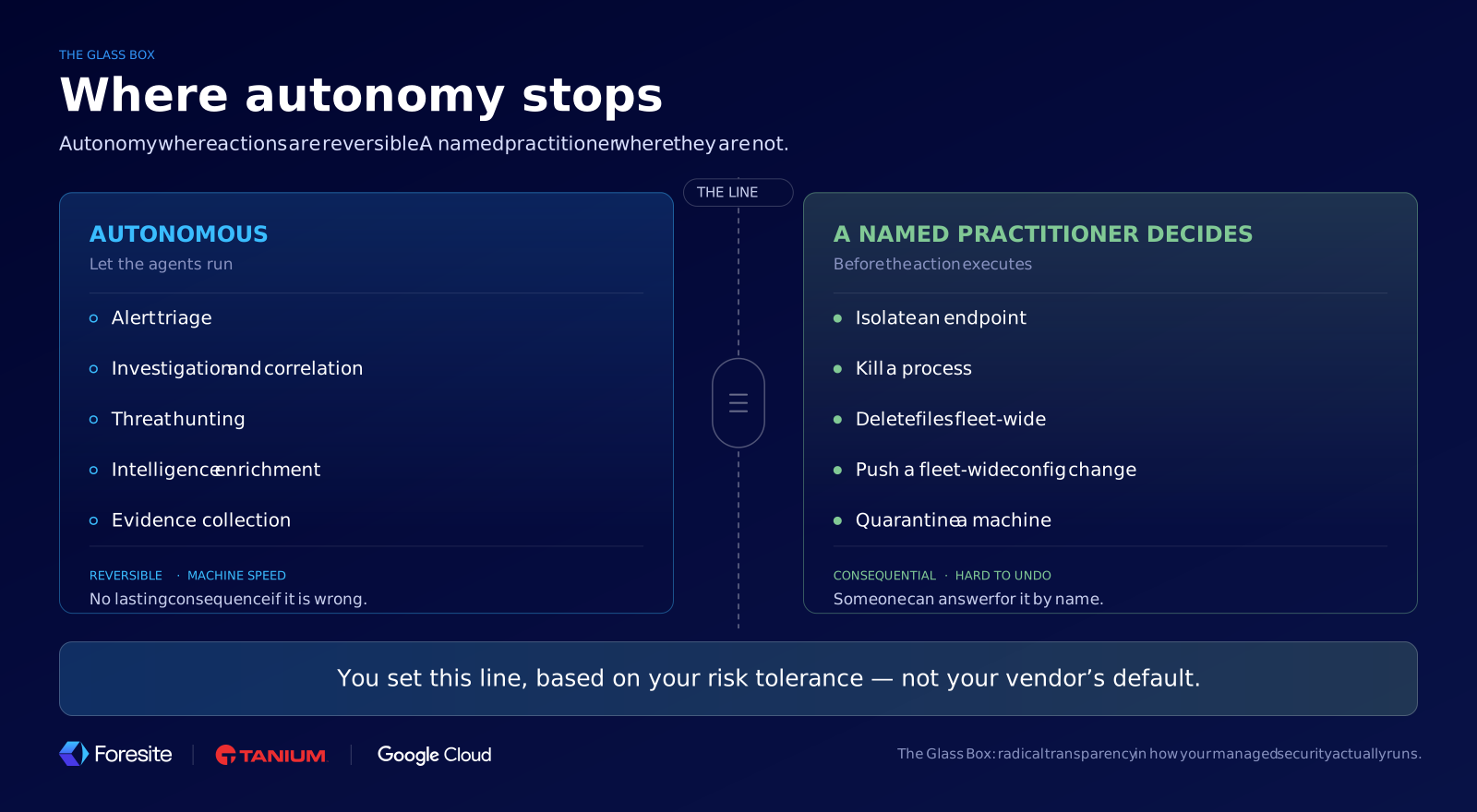
Where autonomy stops: reversible actions run at machine speed, consequential ones wait for a name.
When an agent hits that boundary, who is the named person who decides? A governance model is only as strong as its escalation path. "The system escalates to the SOC" is a start. A named practitioner who knows your environment, sees the agent's full reasoning, and is accountable for the call is the standard we hold ourselves to.
What happens when the agent doesn't know? This is the question we encourage every buyer to ask any autonomous security vendor: which part of the system is allowed to say "I don't know," and what happens next? Confidence-aware escalation with a full reasoning chain is the difference between autonomy you can trust and autonomy you have to babysit.
This is the operating model we call the Glass Box: radical transparency in how your managed security actually runs. Autonomous investigation moves at machine speed, and named practitioners validate every high-impact action before execution. Agentic never means uncontrolled.
The Tanium and Google announcement plays directly to how we already deliver:
On the Google side, Catalyst Citadel, our managed detection and response service, is built natively on Google SecOps, with Google Threat Intelligence enriching what our SOC investigates. The intelligence half of this announcement is telemetry our practitioners already work with.
On the Tanium side, TANIUMaaS gives you the platform with the operational maturity to match it. TANIUMaaS Essentials pairs your in-house team with dedicated expert guidance and continuous platform optimization. TANIUMaaS Complete puts our engineers and 24x7 Cyber Fusion Center hands-on across the full lifecycle, from asset discovery and patching through incident response.
As Atlas's autonomous capabilities roll out, that operating layer is where they become safe to use. Someone has to define the action boundaries, tune the agents to your environment, watch the audit trail, and own the escalations. That is precisely the work a practitioner-led MSSP exists to do.
Foresite is a Tanium Premier Managed Service Provider and Premier Professional & Consulting Services partner, and our engineers are working directly with Tanium's integration team as the first Google SecOps SOAR workflows for these new capabilities take shape.
 |
 |
 |
 |
 |
 |
Here is the shape of the first workflow, and it is worth reading closely:
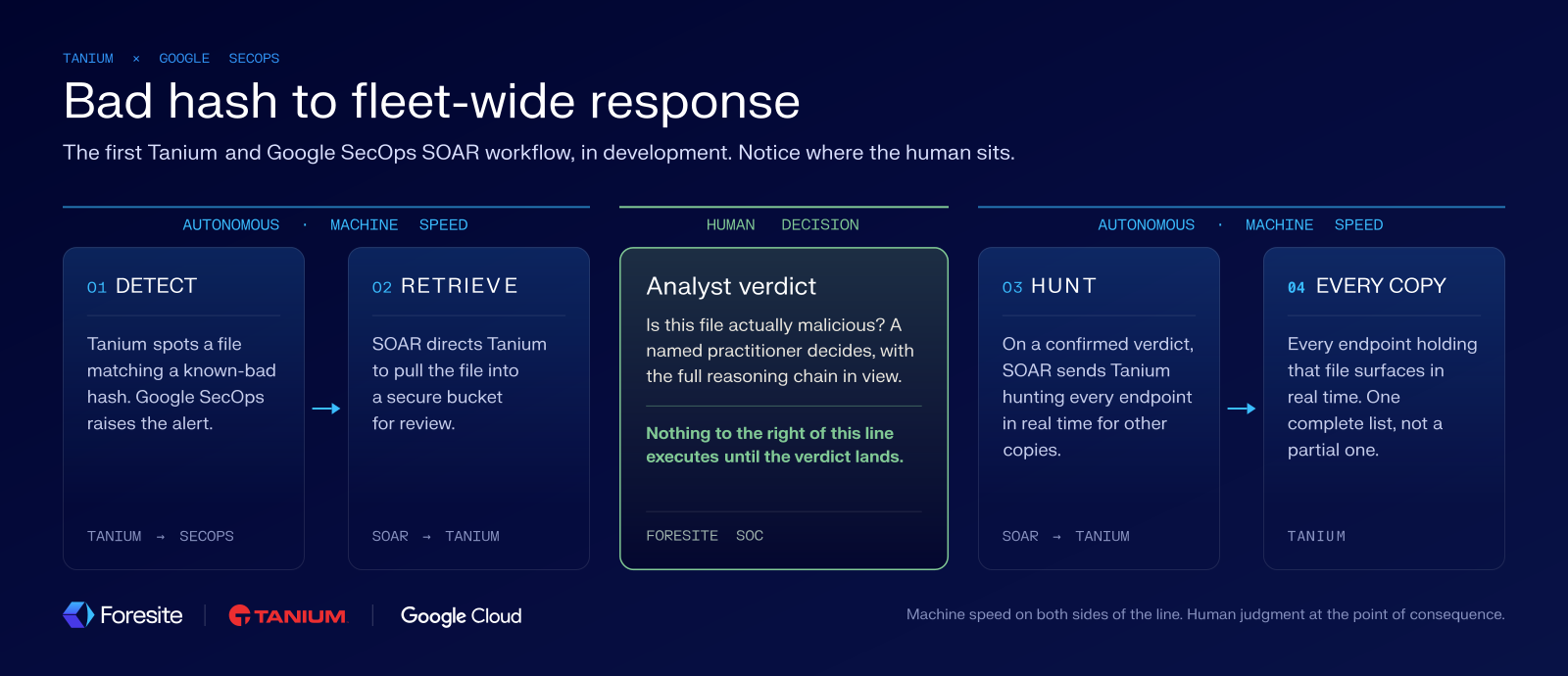
The first workflow in development. Steps run at machine speed; the verdict in the middle belongs to a person.
Notice where the human sits. The detection is autonomous. The fleet-wide hunt runs at machine speed. And the verdict that turns one alert into fleet-wide action belongs to an analyst. That is governed autonomy designed into the workflow itself, with quarantine and further response use cases queued behind it as the integration matures.
These workflows are early and evolving. That is exactly why the operating layer matters: the teams shaping them now are the ones who will run them well.
Autonomous security went mainstream at Black Hat USA 2026, and the Tanium and Google partnership is a strong signal of where the market is headed: intelligence validated against live environments, agents that carry work from alert to resolution, and governance treated as a first-class requirement.
The capability is arriving faster than most teams' ability to govern it. Closing that gap is an operating discipline, and it is the one we've built our entire delivery model around.
If Black Hat left you with a longer list of questions about autonomous security than answers, that is the right reaction. Talk to us about operationalizing it across Tanium and Google SecOps, with a named practitioner accountable for every high-impact action.
Tanium announced autonomous security capabilities in Tanium Atlas, including background AI agents, agent-guided threat hunting, expanded exposure management with Censys internet visibility, and an MCP server for AI platforms. It also announced a private-preview integration bringing Google Threat Intelligence, including Mandiant expertise and VirusTotal data, into Tanium's real-time endpoint visibility.
No. Detection and investigation are strong fits for autonomy because they are fast and reversible. Response and remediation carry real consequences, so mature operating models keep a human decision on high-impact actions. Foresite's Glass Box model runs autonomous investigation at machine speed while named practitioners validate every high-impact action before execution.
Tanium's CTO called ungoverned agents an emerging attack surface, and we agree. Every agent is a privileged non-human identity that can act at machine speed. Without explicit action boundaries, audit trails, and a named escalation path, an agent can propagate mistakes, or be abused, across an entire fleet.
Foresite delivers Tanium-as-a-Service (TANIUMaaS) in two tiers: Essentials, a co-op model where your team keeps hands-on control with our expert guidance, and Complete, where Foresite's engineers and 24x7 Cyber Fusion Center take full operational ownership. Both give you the governance layer that autonomous capabilities require, and both connect into Foresite's Google SecOps-based managed detection and response.