Foresite Catalyst
MXDR for Google Cloud
From AI-driven SecOps to cloud security automation, Foresite delivers fully managed and scalable security solutions tailored for enterprise, hybrid, and multi-cloud environments.
From our Adaptive Security Model to our Google Cloud & Wiz Premier Partnerships, we combine deep expertise, purpose-built technology, and customer-first flexibility.
Combine Google’s native security power with Foresite’s expert-driven, AI-powered operations to secure your cloud and unlock business growth.


On December 7, 2026, every cloud service offering that holds or seeks FedRAMP Certification must follow FedRAMP's new Vulnerability Detection and Response (VDR) and Vulnerability Evaluation and Reporting (VER) rules. If your vulnerability program still runs on a monthly scan, a CVSS-based SLA, and a POA&M spreadsheet, FedRAMP has already told you it is not enough.
I spend much of my week helping cloud providers and SaaS companies that sell to government build security programs that hold up under assessment. This is the most consequential change to FedRAMP continuous monitoring I have seen in years, and the timeline leaves very little room.
On June 10, 2026, CISA issued Binding Operational Directive 26-04, Prioritizing Security Updates Based on Risk. It replaced BOD 22-01 and BOD 19-02 and retired severity-score deadlines for federal civilian agencies. Each vulnerability is now evaluated on four questions:
The answers set the clock. The highest-risk combinations get three calendar days, and the worst of those also require forensic triage to determine whether the system was compromised before it was fixed. Other combinations land at 14 or 60 days. A vulnerability that meets none of the criteria can wait for the next scheduled system upgrade.
The BOD binds agencies, not vendors. FedRAMP closed that gap six days later.
FedRAMP Public Notice NTC-0014, published June 16, pulled mandatory VDR and VER adoption forward. The original plan was June 1, 2027, with a grace period to January 1, 2028. FedRAMP stated plainly that CISA will not accept slow, incremental adoption, and that the legacy monthly scanning process most Rev5 providers follow is insufficient.
The new timeline:
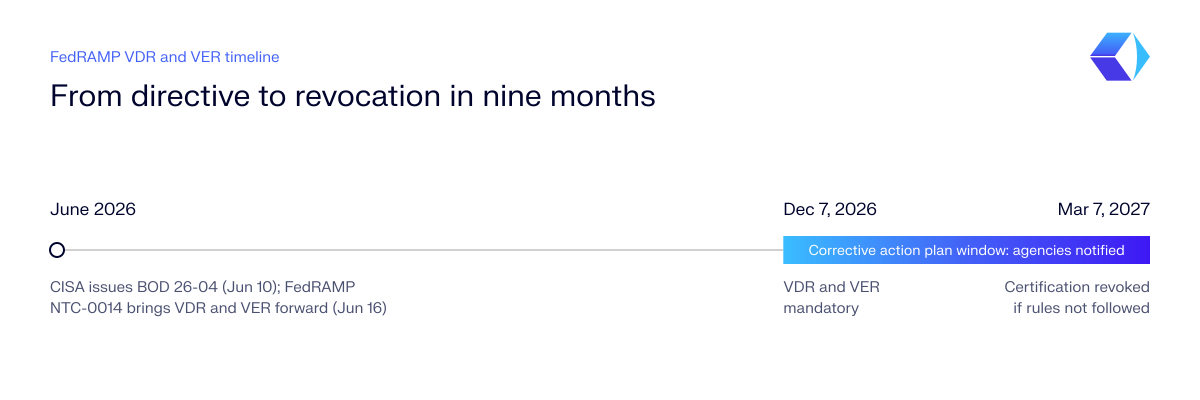
Miss December 7 and certification survives only under a corrective action plan, with every agency customer notified.
Read the middle line twice. A corrective action plan is not a quiet grace period. Every agency customer is told you missed the deadline, which makes it a sales and renewal problem before it is a compliance problem.
FedRAMP confirmed with CISA that providers following VDR and VER will meet or exceed BOD 26-04. In several places the rules go further than the directive. VER requires you to evaluate whether a vulnerability is likely reachable from the internet, not only whether the asset is exposed. VER also requires you to assume an exploit is automatable unless you have evidence it is not. VDR says providers should remediate KEVs by the catalog due date even when they are fully mitigated. For other vulnerabilities, it lets you meet the timeframe by mitigating, for example by removing internet reachability, instead of fully remediating. FedRAMP is also explicit that every timeframe is a maximum, not a target.
Exposure cannot be classified without a current inventory. Public exposure and internet reachability depend on the asset, its network path, and its configuration today. In cloud environments those change by the hour. A monthly scan answers the question for one moment.
KEV moves faster than your scan cycle. CISA adds KEV entries continuously. When a new entry hits an internet-facing workload, the due date is often three days, which leaves no room to wait for next month's scan.
Three days is shorter than most change processes. Ticket creation, owner identification, testing, and change approval can consume three days before anything is deployed.
Forensic triage is a new muscle. For the highest-risk tier, patching is not the finish line. You have to show whether the system was compromised before the fix. In most organizations, vulnerability management and incident response use different tools, different data, and different teams.
Evaluation has to be documented, not just performed. VER is about evaluation and reporting. Assessors and agency customers will expect a record of how each vulnerability was rated and why, especially when you shortened your exposure through mitigation instead of patching.
Disclosure: Foresite is a Premier tier partner in the Wiz Partner Alliance Services Program and a Wiz MSP Program member.
Wiz has published how its platform maps to BOD 26-04, and I have compared those claims against the FedRAMP rules. The fit is strong where the work is data-heavy and time-sensitive. Wiz for Government is also FedRAMP High authorized, which removes a common objection for teams supporting federal workloads.
| Challenge | How Wiz helps | What stays with you |
|---|---|---|
| Exposure classification | Attack Surface Management analyzes network paths to verify internet reachability and tests which exposures are actually exploitable. The Security Graph shows what data and resources sit downstream. | Confirm coverage for assets outside your cloud connectors. |
| KEV correlation | Continuously syncs the KEV catalog and matches new entries against VMs, containers, serverless, and AI workloads. | Connect every account and subscription in your boundary. |
| Timeline assignment | Combines KEV status, automatability, and technical impact from CISA's Vulnrichment data with exposure context, then maps findings to the 3-day, 14-day, 60-day, or next-upgrade tier. | Map BOD tiers to FedRAMP's VDR timeframes, and apply the automatability default (see below). |
| Remediation speed | Routes findings to owners, gives context-specific fix guidance, and traces production findings back to the source repository or image. Wiz Code catches flaws in the pipeline before the clock starts. | A change process that can deploy inside three days. |
| Mitigation as a lever | Provides the context to isolate a component from public exposure, and in many cases ASM can confirm the isolation worked. | Record the mitigation and its validation as VER evidence. |
| Forensic triage | Wiz Defend shows threat detections beside vulnerability data, along with processes, network connections, and identity permissions on the asset. | A written triage procedure, assigned IR roles, and retained evidence. |
The mitigation row is where I see the most immediate value. Outside the KEV catalog, VDR lets you buy time by removing internet reachability, but only if you can prove the exposure is actually gone. Validated isolation turns an urgent fix into a planned remediation, with evidence an assessor can follow. KEVs still need remediation by their catalog due date.
I would be doing you a disservice if I stopped at the table.
Watch the automatability default. Wiz pulls automatability from CISA's Vulnrichment data, which is the right input for the BOD. FedRAMP's VER rules go further: you must assume an exploit is automatable unless you have evidence proving otherwise. If a Vulnrichment value of "no" quietly lowers a finding's tier inside your FedRAMP boundary, you may satisfy the BOD matrix and still fail VER. Set your policy, and your tooling, to treat automatability as "yes" by default.
The tool produces evidence, not decisions. A dashboard that says "three days" does not deploy the patch, approve the emergency change, or decide whether to notify an agency. Those are process and governance choices.
Forensic triage needs a procedure. Wiz shortens the investigation. It does not replace a documented triage workflow, defined roles, and a clear standard for what "not compromised" means.
Scope is wider than cloud. Network appliances, on-premises systems, and anything outside your connected accounts still need coverage and evidence.
CISA has made exposure, exploitation, and evidence the new standard. FedRAMP has made it a condition of certification. The providers that come through this well will be the ones that treat December 7 as the date they are already compliant, not the date they start.
If you want a second set of eyes on your VDR and VER readiness, or help putting Wiz to work inside your FedRAMP boundary, Foresite can help.