Foresite Catalyst
MXDR for Google Cloud
From AI-driven SecOps to cloud security automation, Foresite delivers fully managed and scalable security solutions tailored for enterprise, hybrid, and multi-cloud environments.
From our Adaptive Security Model to our Google Cloud & Wiz Premier Partnerships, we combine deep expertise, purpose-built technology, and customer-first flexibility.
Combine Google’s native security power with Foresite’s expert-driven, AI-powered operations to secure your cloud and unlock business growth.

Update, October 29: Exploitation is confirmed in the wild. Amazon Threat Intelligence logged an attempt on October 17, four days before disclosure, and the PHP team received the first report on August 11. Review your logs from August 1, not from your patch date.
If your organization runs WordPress, Magento, Drupal or any PHP-based site, PHP2Shell needs your attention this week.
On October 20, details of two critical PHP vulnerabilities leaked online before a fix existed. They are tracked as CVE-2026-109618 and CVE-2026-109619, and both are rated 9.2 under CVSS v4.0. The PHP project shipped emergency patches on October 21.
This is not a plugin bug or a single CMS problem. It sits in PHP itself, so the exposure follows the runtime wherever it is deployed.
Both flaws allow unauthenticated remote code execution. An attacker can take over a web server with a single crafted request, before your application code runs. No login, no user interaction. A related flaw lets attackers read server memory, which can hold passwords, tokens and API keys.
The leak changed the timeline. Amazon Threat Intelligence saw an exploit attempt on October 17, before disclosure, and exploitation is now confirmed in the wild. Unit 42 reported that attackers used PHP2Shell against a European government entity and reached password hashes and MFA secrets within two hours. Public exploit code is circulating.
The scale is large. Palo Alto Networks Unit 42 counts more than 22.6 million exposed instances that are potentially vulnerable, and Wiz says PHP powers 70% of websites. Government cyber agencies in the UK, Canada, Australia and the EU urged operators to take sites offline until patched. Finland's government and the Dutch House of Representatives disconnected theirs. (Cybersecurity Dive)
Two teams found the flaws independently. Wiz Research, now part of Google, used its Wiz Atlas tool and Google's Gemini 4 Argon. Calif used OpenAI's GPT-5.6 Sol. Both worked with the PHP team on the fix. The bugs had sat in PHP's core engine for more than a decade, and frontier AI made a complex exploit chain practical in days.
That is the bigger lesson. Attackers have the same models. Old, hard-to-exploit flaws are now realistic targets, and the window between disclosure and attack keeps shrinking.
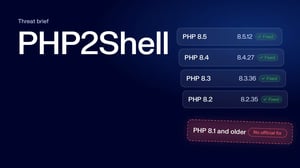
Public reporting puts affected versions as far back as PHP 5.4. Fixes are available for supported branches only:
|
Branch |
Fixed version |
|
PHP 8.5 |
8.5.12 |
|
PHP 8.4 |
8.4.27 |
|
PHP 8.3 |
8.3.36 |
|
PHP 8.2 |
8.2.35 |
|
PHP 8.1 and older |
No official fix |
That last row is the real problem. Legacy apps, forgotten marketing microsites and vendor appliances often run end-of-life PHP. They will stay exploitable until they are upgraded, isolated or retired.
Online stores carry extra risk. An attacker with code execution can plant a hidden card skimmer on a checkout page and collect payment data for weeks before anyone notices.
Most teams can deploy a patch. The harder question is whether someone validated the threat before the patch existed, knew exactly which systems were exposed, and is still watching for what comes next.
When PHP2Shell leaked, our SOC validated the threat and notified customers with payment environments first, then the rest of our base. We are building detections with our technology partners and supporting customers through patching and end-of-life decisions. Our 24x7 SOC runs on Google SecOps, with named practitioners reviewing every high-impact action. That combination of machine speed and human accountability is a big part of why Google named Foresite its 2026 Google Cloud Security Partner of the Year for North America.
We’re offering a free PHP2Shell exposure check across your internal and external network, with no agent install. In 30 minutes we’ll show you where you stand and what to fix first.
Book a free PHP2Shell exposure check → · Download the PHP2Shell threat brief →
What is PHP2Shell? Two critical vulnerabilities in the PHP runtime, CVE-2026-109618 and CVE-2026-109619, that allow unauthenticated remote code execution on web servers.
Am I affected if I use WordPress? If your WordPress site runs on an unpatched PHP version, yes. The flaw is in PHP, not WordPress, so updating WordPress alone does not fix it.
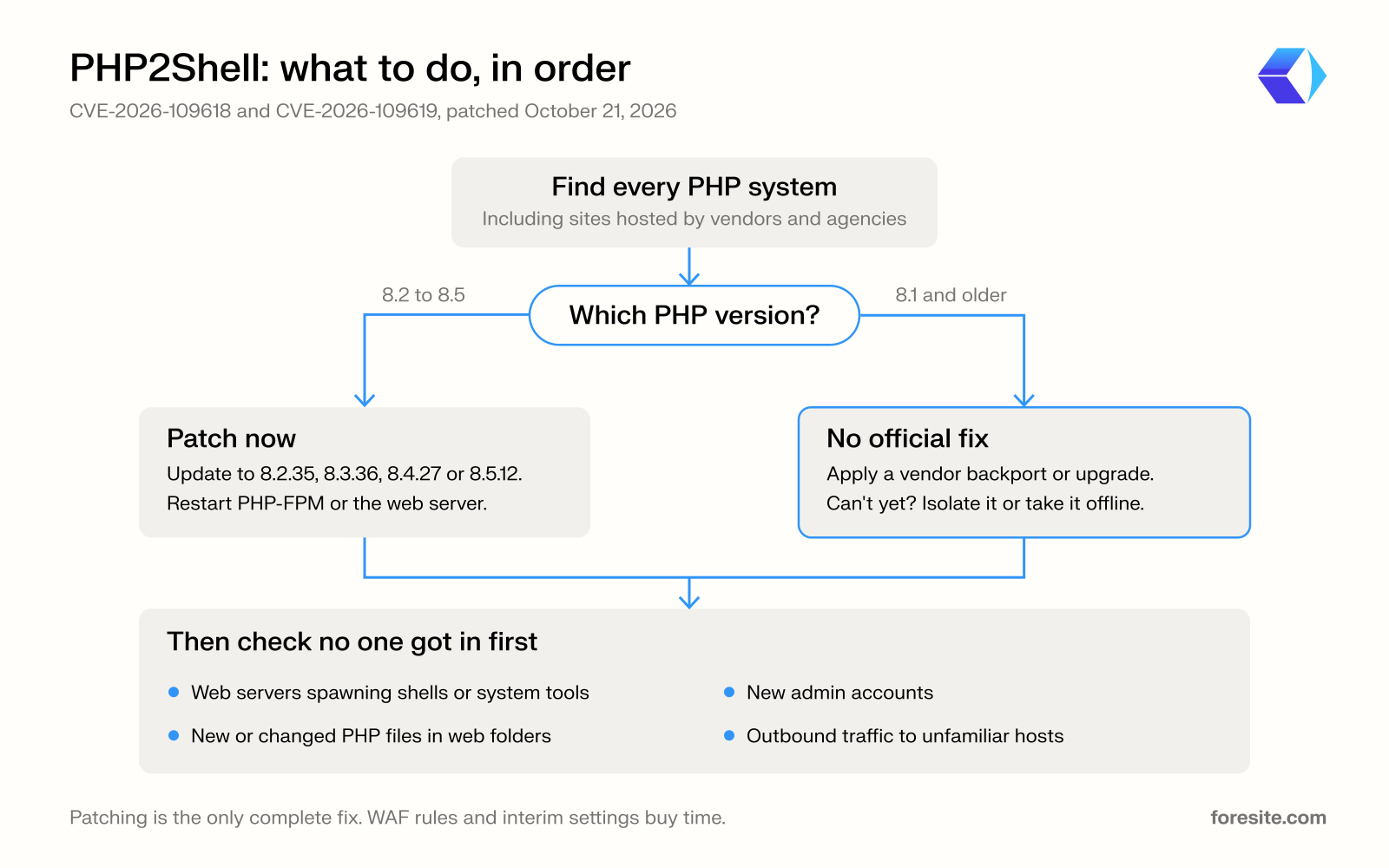
Which PHP versions are fixed? PHP 8.5.12, 8.4.27, 8.3.36 and 8.2.35. PHP 8.1 and older will not receive official fixes.
Is PHP2Shell being exploited? Yes. Exploitation is confirmed in the wild, and Amazon Threat Intelligence saw an attempt on October 17, four days before disclosure. Public exploit code is available.
I patched. Am I safe? Patching closes the door. It does not remove an attacker who got in before you patched. Review your logs back to August 1 for signs of an intruder.
Should I take my site offline? If you cannot patch or contain it today, yes. That is what UK, Canadian, Australian and EU cyber agencies advised.
Sources: PHP security advisory, Wiz Research, Amazon Threat Intelligence, Google Cloud, OpenAI, Unit 42, Wired, Cybersecurity Dive, watchTowr, SecurityWeek, Brandefense.